07 January 2025

Research

The primary downside risk factor in our economic scenario remains financial instability.

Christophe Morel
Christophe Morel, Chief economist

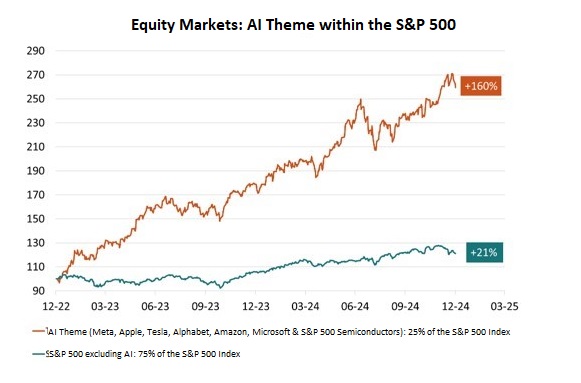
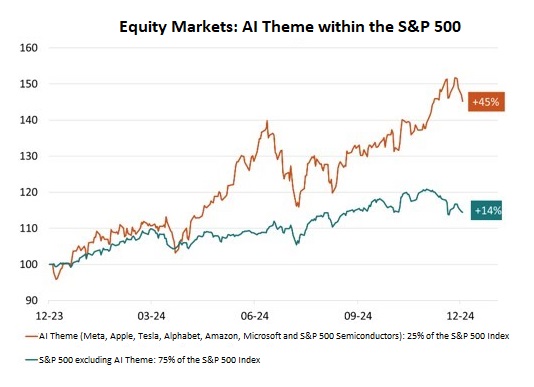
Our analysis of the impact of uncertainty on economic activity shows that renewed tensions could weigh on growth and delay the recovery in investment (see The Impact of Economic Uncertainty on Investment (groupama-am.com)). However, when uncertainty is already high, it is more likely to decline than to increase further. Consequently, the primary downside risk in our scenario is not linked to political, geopolitical, or trade-related uncertainty. In the "risk balance" underpinning our economic scenario, the main downside factor lies elsewhere, namely in financial instability and, more specifically, in U.S. equity markets (see the table "Risk Balance in Our Economic Scenario for Autumn 2024"). Following the strong rise in U.S. equities in 2024, driven by the AI theme, this risk factor has logically become more significant (see Charts 1 & 2).

Return to a More "Balanced" Risk Assessment

Positive (+)
Negative (-)
  • More accommodative monetary policies (particularly in emerging markets)
  • Extension of fiscal support measures
  • Oil price counter-shock
  • Synchronized recovery in industry
  • Stronger investment multiplier effects
  • Significant use of excess household savings in Europe supporting consumption
  • Financial instability: excesses in equity markets followed by a correction, sharp rise in bond yields, decline in real estate prices
  • Resurgence of the trade war
  • Political risks (elections in the United States, Germany, etc.) and social unrest
  • Escalation of regional conflicts (Ukraine, Middle East), creating new supply bottlenecks and higher commodity prices
  • Restrictive fiscal policies and delays in the implementation of public plans

Reading note: The risk assessment indicates the most likely direction of a revision to our growth forecasts. Thus, a risk assessment now described as "balanced" means that an upward revision of growth projections is considered as likely as a downward revision.
Source: Bloomberg – Calculations: Groupama AM
Source: Bloomberg – Calculations: Groupama AM

The valuation diagnosis of equities should not be conducted against a "historical average", which is rarely a relevant benchmark. Just as bond yields are always assessed in light of prevailing economic conditions, equity analysis must also be framed within the broader macroeconomic environment.

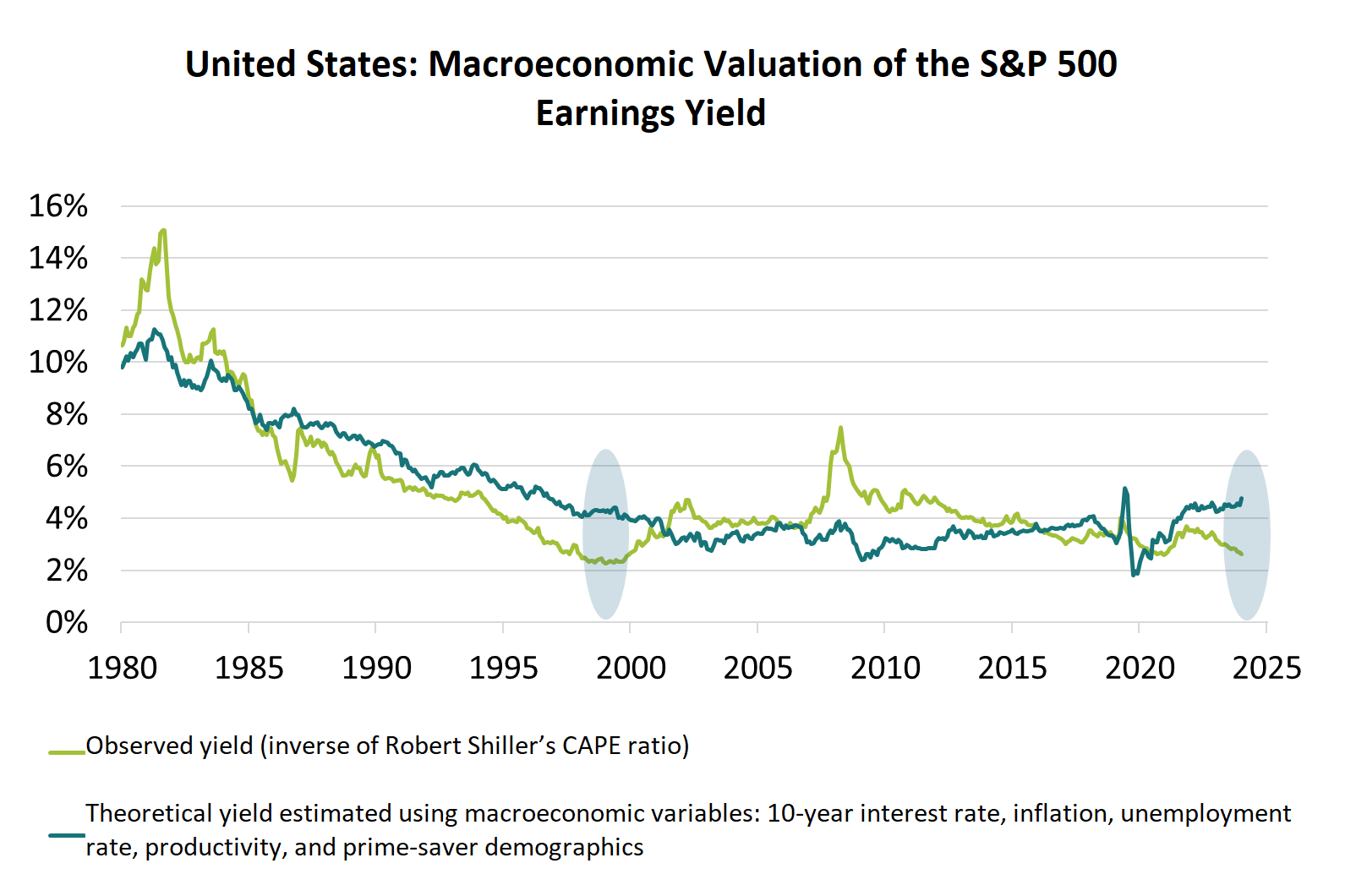
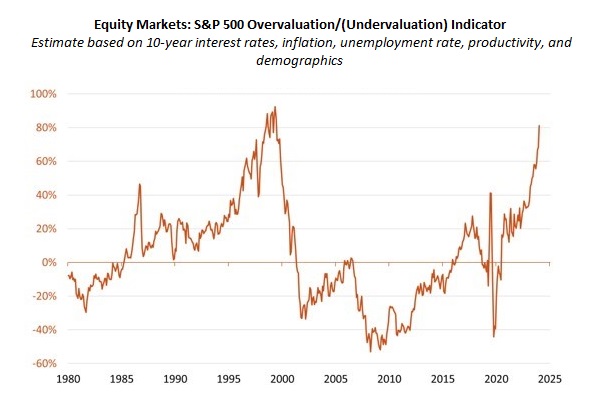
With this in mind, we have modelled the return on U.S. equities, using the inverse of Robert Shiller’s CAPE ratio (the cyclically adjusted price-to-earnings ratio), based on five economic variables: interest rates, two cyclical indicators (the unemployment rate and inflation), and two structural factors (productivity and demographics, measured by the share of the population aged 30 to 64 in the total population). The gap between the observed equity return and its "theoretical" return therefore provides a valuation measure that takes into account the prevailing economic regime.

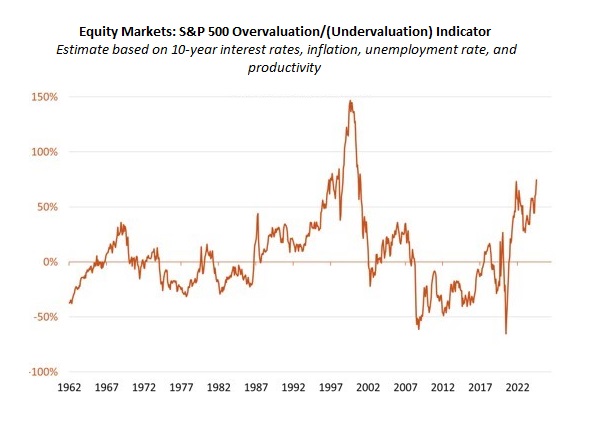
Our statistical analysis shows that the rise in equity markets during 2024 pushed U.S. equity returns into an "abnormally low" zone relative to both cyclical and structural fundamentals (Chart 3). Current equity returns are "too low" compared with their theoretical level, implying, in principle, a significant increase in dividends, potentially complemented by an adjustment in equity prices. While the magnitude of the valuation gap varies depending on the model used, all models indicate that the divergence has now reached levels not seen since the late 1990s (Charts 4 and 5).
Source: Bloomberg – Calculations: Groupama AM

Source: Bloomberg – Calculations: Groupama AM

Source: Bloomberg – Calculations: Groupama AM

In terms of financial investment, a valuation gap does not necessarily mean that a cautious strategy should be applied. It may make sense to follow the momentum, especially since it would be 'presumptuous' to predict when this risk will materialize. Our previous work on optimal strategy during periods of overvaluation has shown that caution can be costly if a market consolidation does not occur quickly, even in the case of excess. For example, a 'short' position in stocks taken in March 1999 (one year before the bursting of the bubble) would have underperformed a 'long' position until March 2001 (one year after the burst), until the gains of the 'long' position were entirely offset by those of the 'short' position.

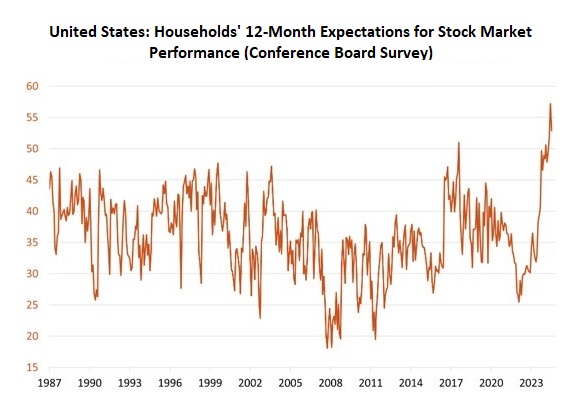
On the other hand, from a macroeconomic perspective, our analysis leads us to avoid complacency: financial instability remains the primary downside risk in our scenario. At the very least, our scenario is contingent on not experiencing significant microeconomic disappointments in the 'AI galaxy' that could raise doubts about macroeconomic productivity gains. A correction in U.S. stocks would penalize consumption through the wealth effect and weigh on investment through a higher cost of capital. Many investors point to geopolitical and political risks, while sentiment on U.S. stocks has become largely positive (see Graph 6). Our risk hierarchy, therefore, differs from that of the Consensus.

Source: Bloomberg – Calculations: Groupama AM

DISCLAIMER

This document is intended for informational purposes only. Groupama Asset Management and its subsidiaries disclaim any liability in the event of alteration, distortion, or falsification of this document. Any unauthorized modification, use, or distribution, in whole or in part, in any form whatsoever is prohibited. Before making any investment, investors must review the prospectus or the Key Investor Information Document (KIID) of the UCITS. These documents, along with other periodic reports, are available free of charge upon request from Groupama AM or at www.groupama-am.comThis non-contractual document does not constitute a recommendation, a solicitation, or an offer to buy, sell, or trade, and should not be interpreted as such. The sales teams of Groupama Asset Management and its subsidiaries are available to provide you with personalized recommendations.

Published by Groupama Asset Management – Registered office: 25 rue de la Ville l’Évêque, 75008 Paris – Website: www.groupama-am.com

Discover also